When Tech Stopped Being For Us
I don’t connect with the current tech landscape.
I've been saving articles lately that all share an uncomfortable feeling: disconnection. Not burnout—disconnection. The difference matters.
Burnout is temporary, recoverable. You take a break, touch grass, come back refreshed. Disconnection is deeper. It's the slow realization that the thing you once loved has fundamentally changed, and not in your favor.
Riccardo Mori nailed it in November: "Technology's evolution from empowering tool to profit-driven, hype-driven ecosystem has left long-time enthusiasts feeling disillusioned, disconnected, and increasingly skeptical of an industry that now seems to serve itself more than its users."
The Shift Nobody Wanted
Somewhere along the way, tech stopped being a tool we wielded and became a system that wields us. This wasn't an accident. It was a business model optimization.
The clearest example? Social media. Charlie Warzel's piece on X as a "worthless, poisoned hall of mirrors" isn't hyperbole—it's careful documentation of what happens when a platform's incentives completely divorce from user value. These services were supposed to connect us, facilitate conversations, democratize information. Instead, they became engagement machines optimized for advertiser revenue and whatever keeps us scrolling, regardless of the psychological cost.
Twitter used to be where you found your people. Now X is where algorithms decide what enrages you enough to stick around. The transformation is complete, and it's repulsive.
The AI Benchmark Circus
AI took the same path, just faster. We're drowning in announcements about which model scored 0.3% better on some synthetic benchmark nobody actually uses. Meanwhile, the actual user experience—the thing that matters—gets treated as an afterthought.
Federico Viticci pointed this out in November: what differentiates AI products now isn't raw capability, it's the experience wrapped around that capability. But here's the thing—experience for whom? The companies need you locked into subscriptions, feeding their models with your data, accepting whatever interface they deign to provide. They're optimizing for their business metrics, not your actual needs.
The benchmark obsession is a distraction. It lets companies compete on numbers while ignoring whether their products actually improve anyone's life.
What We Actually Lost
Remember when tech felt like it was for something beyond quarterly earnings?
RSS feeds that let you read what you wanted, when you wanted, from sources you chose—without an algorithm deciding what you "should" see. Software you purchased once and owned, rather than rented month-to-month with features that could vanish in the next update. Platforms that didn't require constant feeding with personal data just to function at a basic level.
That web wasn't perfect. But it had a fundamentally different relationship with users. Tools were designed to empower you to do something. Now they're designed to keep you engaged, monitored, monetized.
The shift from ownership to access meant we stopped being customers and became inventory. Your attention is the product being sold. Your data is the raw material being refined. The actual service? That's just the vehicle for extraction.
Every Interaction, Intermediated
Here's what gets me: you can't just do things anymore. Every interaction has to run through someone else's infrastructure, someone else's algorithm, someone else's business model, someone else's terms of service that change whenever convenient.
Want to share photos with friends? That's not just hosting files anymore—it's feeding Facebook's or Instagram's engagement metrics. Want to publish your thoughts? Medium wants to paywall them and take a cut. Want to message someone? iMessage, WhatsApp, Signal, Telegram—each one another walled garden, another platform hoping you'll bring all your contacts with you.
The promise was connection. The reality is fragmentation controlled by intermediaries who profit from your inability to leave.
The Hype Cycle Ate Everything
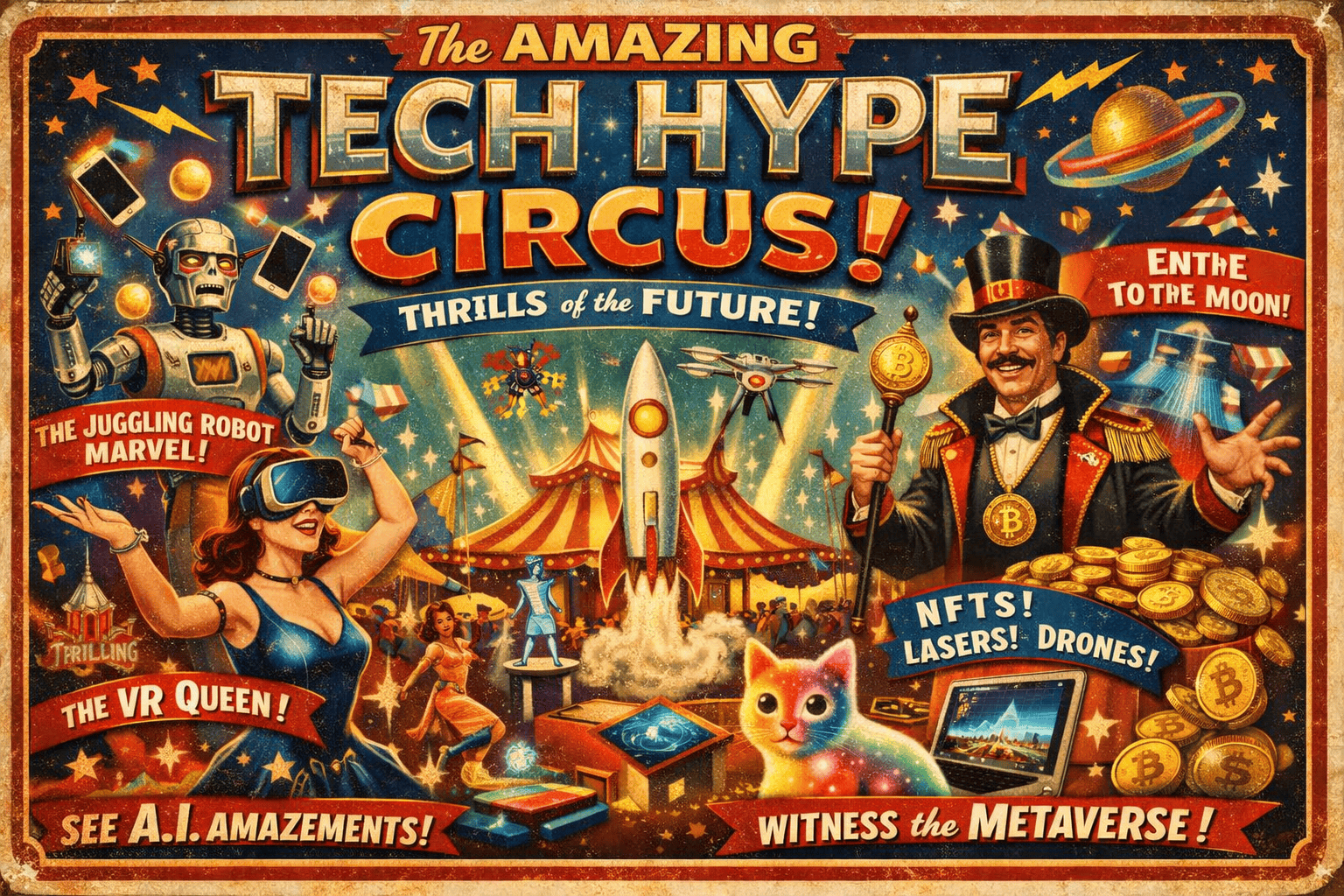
And then there's the relentless hype. Every minor iteration gets breathlessly announced as revolutionary. Every feature gets a marketing name and a keynote slide. Every change gets framed as innovation, even when it's just a new way to extract value.
Remember when we got excited about technology because it genuinely expanded what was possible? Now we're exhausted by an industry that discovered it's more profitable to promise the future than to deliver the present.
The AI boom is the apotheosis of this. Fundamental questions about utility, ethics, environmental cost—all drowned out by investor excitement and billion-dollar valuations for companies that haven't figured out sustainable business models beyond "charge enterprises a fortune and hope."
Why the Enthusiasts Are Leaving
The people checking out aren't technophobes. We're not afraid of change or nostalgic for some imaginary golden age. We're the people who built this stuff, who championed it, who got others excited about it, who believed in its potential.
And we're watching it curdle into something unrecognizable.
The disillusionment isn't about the technology failing. It's about realizing the technology is working exactly as designed—just not for us. We're not the beneficiaries; we're the resource being harvested.
That's the disconnection Mori described. When you realize the thing you loved has been optimized for someone else's benefit, and your role is just to keep feeding the machine.
What Now?
I don't have a tidy answer. "Vote with your wallet" doesn't work when the entire industry has converged on the same exploitative models. "Build alternatives" is noble but exhausting when you're fighting trillion-dollar network effects.
What I do know: naming the problem matters. Recognizing that your discomfort isn't personal failure or inability to keep up—it's a rational response to a system that's stopped serving you.
The tech industry wants you to believe the only path forward is more—more AI, more platforms, more subscriptions, more integration, more data sharing. But maybe the actual path is less. Smaller tools, more ownership, fewer intermediaries, more intention about what you let into your life.
We didn't sign up to be monetized. We signed up to be empowered.
It's worth remembering the difference.